Elevator, ventilation, fire protection: one building, one file.
A single building often has ten or more service providers: for elevators, heating, ventilation and air conditioning, fire alarm and sprinkler systems, smoke extraction, gates and emergency power. Elevators are our reference case: for them there is evi by elevator intelligence, the AI for elevator operators. Main inspection, emergency call, maintenance contract: the same documents and the same questions every year. vi carries the principle over to every technical asset in the building.
evi by elevator intelligence.
Elevators have their own AI: evi knows main inspections, emergency calls, maintenance contracts and repair quotes around the elevator. vi grew out of this principle and carries it over to ventilation, fire protection and every other asset in the building.
elevatorintelligence.com ↗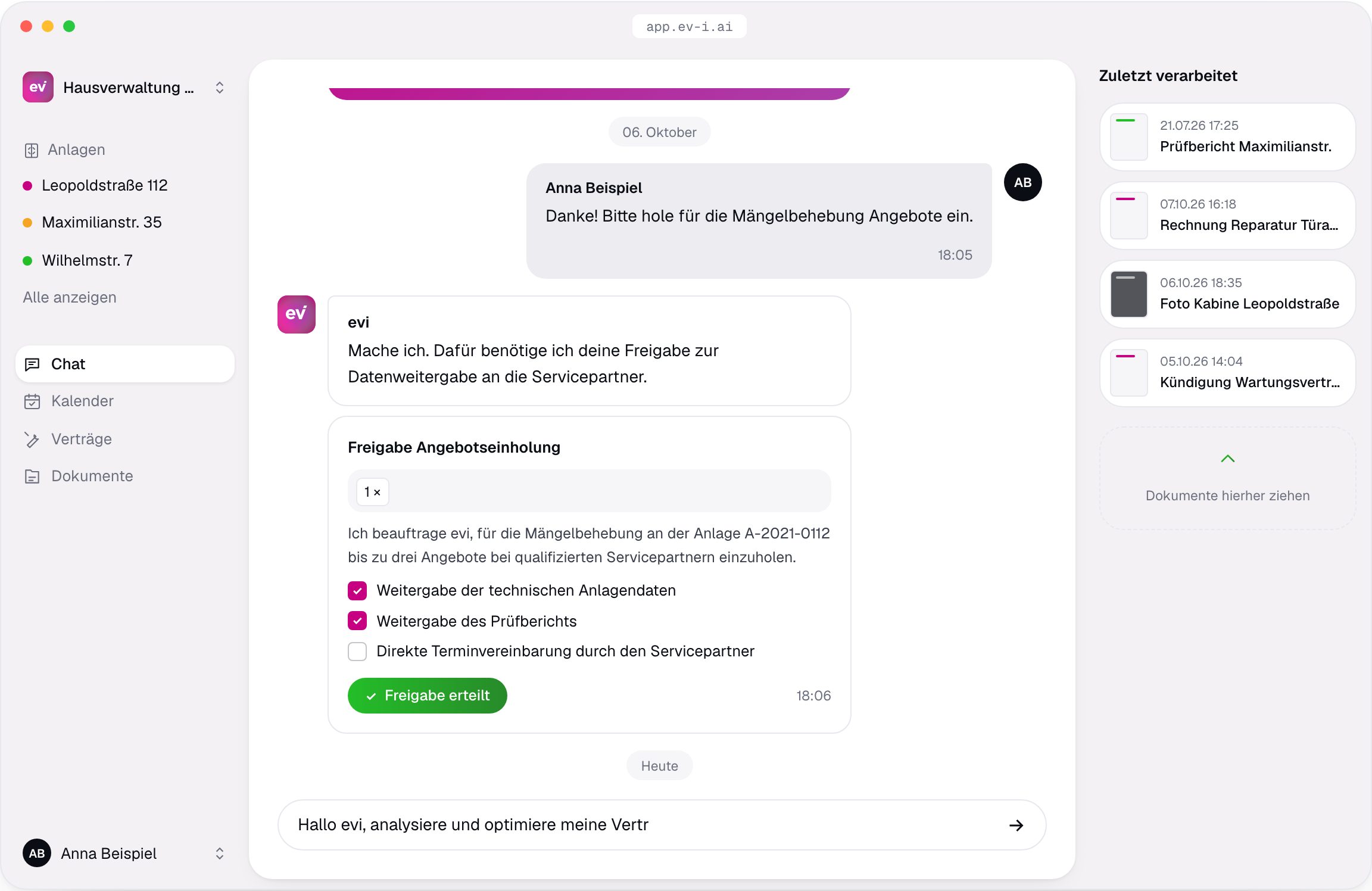

- Elevators and escalators
- Heating and heat pumps
- Ventilation and air conditioning
- Fire alarm and voice alarm systems
- Sprinklers, smoke and heat exhaust
- Emergency power and safety lighting
- Gates, doors and barriers
On the right is an example from this industry: documents arrive in the chat, vi reads them, assigns them and suggests what to do. Assets, companies and amounts are made up.
| Defect | Deadline | Severity |
|---|---|---|
| Emergency call connection | 4 weeks | significant |
| Cabin light | 3 months | minor |
| Shaft pit | next maintenance | minor |
What lands on your desk.
Inspection reports from inspection bodies
Elevators need a main inspection at least every two years and an interim inspection in between, with defects and deadlines.
Reports from inspection experts
Safety systems such as fire alarm systems or smoke extraction are inspected periodically under the inspection ordinances of the German federal states.
Maintenance contracts
Basic or full-service maintenance, intervals, emergency call connection, response times. Every trade has its own contract.
Hygiene and energy inspections
Hygiene inspections for ventilation systems under VDI 6022 and energy inspections of air conditioning systems under the German Building Energy Act (GEG).
Quotes and invoices
Repairs, modernizations and defect correction, often commissioned through the property management on behalf of the owner.
Where things usually go wrong.
Full-service maintenance in the operating cost statement
Full-service maintenance contracts include a share for repairs. That share does not belong in operating costs, but often ends up there.
Defects stay open
The inspection report goes to the property management, the defect to nobody. At the next inspection it shows up again.
Emergency call over outdated technology
Elevator emergency calls and alarm connections partly run on older mobile network standards. When networks are shut down, the equipment must be retrofitted.
Ten companies, ten formats
Every service provider sends reports and invoices differently. Anyone who wants an overview retypes everything.
Read, check, plan.
All trades in one file
vi reads the reports, contracts and invoices of every trade and assigns them to the building and the asset.
Separate operating costs cleanly
vi separates maintenance from repair in contracts and invoices so that the statement is correct.
Defects through to proof
Every defect becomes a ticket with a deadline. The proof of correction is linked to the inspection body.
Maintenance contracts compared with the market
Scope and price of every contract are checked against comparable assets, with an especially large number of comparison values for elevators.
Office building with two elevators and a ventilation system
A property manager looks after an office building with two elevators, a ventilation system, a fire alarm system and an underground garage gate. Five service providers, five contract terms.
This workflow is an example. Figures and findings are chosen for illustration.
- 1
Upload
Inspection reports, maintenance contracts and last year's invoices go to vi in one batch.
- 2
Read
Elevator A passed the main inspection with one defect in the emergency call connection, deadline four weeks. For the ventilation system, filter changes are not in the contract.
- 3
Organize
vi separates maintenance and repair for the operating cost statement and puts the inspection dates of all trades into one calendar.
- 4
Resolve
The ticket for the emergency call goes to the elevator company, and a request for a flat-rate filter fee is prepared. The property management approves.
What applies to this industry.
A selection of the rules that govern maintenance, inspection and service in this industry. Each with key dates and sources.
German Ordinance on Industrial Safety and Health (Betriebssicherheitsverordnung)
F-gas Regulation (EU) 2024/573
DGUV Regulation 3: Electrical Installations and Equipment
Cyber Resilience Act (EU) 2024/2847
NIS2 Directive (EU) 2022/2555
Data Act (EU) 2023/2854
Short answers.
Questions in detail.
Expand a question for the answer, the original wording of the rules and links to the official text.
How often is an elevator inspected, and what is the intermediate inspection?
Elevators are inspected by an approved inspection body, not by the service company. The main inspection recurs. As the operator, you set the interval in your risk assessment, but it must not exceed two years. In the middle of the inspection period comes the intermediate inspection, also by the inspection body. It consists of visual and simple functional checks of the safety devices and the inspection of selected safety-relevant components. With a two-year interval, it falls about one year after the main inspection.
If the inspection body considers your interval too long, you shorten it in agreement with the body. If you disagree, the authority decides. For elevators, too, an inspection may take place up to two months after the due date without counting as late. In the car, a marking must be clearly visible that shows the month and year of the next recurring inspection and who inspects, usually as an inspection sticker.
After a change that requires inspection, the inspection body must inspect before the elevator runs again. vi reads the inspection report and enters the main inspection and the intermediate inspection into the calendar.
“Elevator installations within the meaning of number 2 must be inspected at regular intervals by an approved inspection body (main inspection). […] The inspection interval must not exceed two years.”
Unofficial translation
“In addition to the inspection under number 4.1, an inspection must be carried out in the middle of the inspection period between two inspections under number 4.1 (intermediate inspection).”
Unofficial translation
“Notwithstanding the records and inspection certificates under paragraph 1, a marking, for example in the form of an inspection sticker, must be clearly visible and permanently attached in the car of elevator installations, showing the month and year of the next recurring inspection and the inspecting body.”
Unofficial translation
What do I have to handle myself as an elevator operator between inspections?
Three things are yours, regardless of the maintenance company and the inspection body.
First, the emergency call and the emergency plan. A two-way communication system must work in the car, and through it an emergency service must be reachable at all times. The emergency plan must contain at least: the location of the installation, details of the responsible employer, persons with access to all parts of the installation, persons who can free trapped people, contact data for first aid, the expected start of a rescue and the rescue instructions. If a phone number or a contact person changes, the plan and the call connection change with it.
Second, the regular check for obvious defects. That is a visual check by an instructed person, for example the building caretaker, against a fixed list. How often is something you set in the risk assessment, and you should record the result in writing.
Third, maintenance. It depends on the type and intensity of use. A heavily used elevator needs more attention than one that rarely runs. That belongs in the maintenance contract and not in a flat rate. In addition, the machine room may only be accessible to authorized persons, and no equipment that endangers safe operation may be placed in the immediate area of the installation.
“Whoever operates an elevator installation under Annex 2 Section 2 number 2 letter a must ensure that a two-way communication system is effective in the car of the elevator installation, through which an emergency service can be reached at all times.”
Unofficial translation
“Whoever operates an elevator installation under Annex 2 Section 2 number 2 must check it regularly for obvious defects that may impair safe use.”
Unofficial translation
“Whoever operates an elevator installation under Annex 2 Section 2 number 2 must take maintenance measures under § 10 taking into account the type and intensity of use of the installation.”
Unofficial translation
What does a full-service contract mean for the operating cost statement?
A full-service contract covers repairs and spare parts as well as maintenance, and that is exactly the catch for the statement. Under the Ordinance on Operating Costs, operating costs are the ongoing costs that arise from the intended use. Expressly excluded are maintenance and repair costs, meaning the costs of fixing defects caused by wear, aging and weather.
For the elevator, § 2 no. 7 lists as chargeable: operating power, supervision, operation, monitoring and care, the regular testing of operational readiness and safety including adjustment by a specialist, and cleaning. Repairs and parts are not on that list.
In practice, the share for repairs and parts must be taken out of the full-service price before the rest is passed on to tenants, as far as the lease allows charging operating costs. The cleanest case is a contract that prices maintenance, fault clearing and parts separately. Without that split, all that remains is an estimate, and that can lead to disputes. Also make sure that no repairs are billed on top of full service that the contract already covers. vi separates maintenance from repair in contracts and invoices and shows the shares for each building. You prepare the statement itself.
“Operating costs do not include: […] the costs that must be incurred during the period of use to maintain proper use, in order to properly remedy structural or other defects arising from wear, aging and weathering (maintenance and repair costs).”
Unofficial translation
“the costs of operating the passenger or freight elevator, which include the costs of operating power, the costs of supervision, operation, monitoring and care of the installation, of regular testing of its operational readiness and operational safety including adjustment by a specialist, and the costs of cleaning the installation;”
Unofficial translation
Does my air-conditioning system need an inspection and a leak check?
Two separate duties apply to air-conditioning systems in buildings.
The first is the energy inspection under the Building Energy Act. It applies to air-conditioning systems and combined air-conditioning and ventilation systems with a nominal output for cooling demand of more than 12 kilowatts. The first inspection is due in the tenth year after commissioning or after the renewal of essential components such as heat exchanger, fan or refrigeration machine, and then at the latest every ten years. You have an authorized person carry it out. There are exceptions, for example for non-residential buildings with building automation under § 56 paragraph 5.
The second is the leak check under the F-gas Regulation. It covers systems with fluorinated greenhouse gases from 5 tonnes of CO2 equivalent. Hermetically sealed, correspondingly labeled equipment below 10 tonnes of CO2 equivalent is excluded. The interval depends on the charge: below 50 tonnes at least every twelve months, or every 24 months with a leakage detection system installed. Between 50 and 500 tonnes it is six and twelve months. Certified personnel carry out the check.
The two duties are independent, but the appointments can be combined. vi reads the refrigerant and charge from the equipment log and derives the interval.
“The operator of an air-conditioning system installed in a building with a nominal output for cooling demand of more than 12 kilowatts, or of a combined air-conditioning and ventilation system with a nominal output for cooling demand of more than 12 kilowatts, must have energy inspections of this system carried out within the periods stated in § 76 by an authorized person within the meaning of § 77 paragraph 1.”
Unofficial translation
“The inspection must first be carried out in the tenth year after commissioning or after the renewal of essential components such as heat exchanger, fan or refrigeration machine.”
Unofficial translation
“for equipment that contains less than 50 tonnes of CO2 equivalent of fluorinated greenhouse gases listed in Annex I or less than 10 kilograms of fluorinated greenhouse gases listed in Section 1 of Annex II: at least every 12 months; or where a leakage detection system is installed in such equipment, at least every 24 months;”
Who is the operator when a property manager runs the building?
The operator is whoever uses the installation for commercial or economic purposes. For a rented building, that is usually the owner. The Industrial Safety Ordinance states explicitly that such operators are treated like employers. The duties for inspection, defect correction, emergency call and maintenance therefore rest with them.
In practice, the property manager takes over the tasks: ordering inspection appointments, steering service companies, initiating repairs, organizing the emergency service. Tasks can be delegated, but the duty to see that they are done stays with the operator. That is why the management contract should say who does what by when. Put in writing who receives the inspection reports, who may approve defect repairs up to what amount, who can be reached for an emergency call and how quickly the owner is told about defects with a deadline.
This matters more than it sounds. Inspection reports often go to the manager. If the owner does not see them, the defect appears again in the report at the next inspection. A shared overview of all installations with deadlines and responsibilities prevents that. vi assigns inspection reports and defects to the building and shows who has to do what by when.
“An employer is treated as equivalent to […] a person who, without being an employer, uses an installation subject to monitoring for commercial or economic purposes, […]”
Unofficial translation
“The operator of an installation subject to monitoring must ensure that the installation is inspected for safe and proper condition 1. before first commissioning, 2. before recommissioning after changes requiring inspection, 3. after extraordinary events and 4. at recurring intervals.”
Unofficial translation
What should I look for in an elevator maintenance contract, and how do I spot an inflated price?
Start with the terms. Under basic maintenance, the company owes the regular maintenance work according to the manufacturer's instructions and a work plan, and fault clearing and parts come extra. Full service includes repairs and spare parts, usually with exceptions. These terms are not fixed legal concepts, so the description of services decides. Read the list of exclusions with particular care, because that is where it is decided what is really covered when something breaks.
Also clarify how often maintenance takes place and whether that follows the use, since the law requires maintenance that takes the type and intensity of use into account. Clarify who answers the emergency call, what response time applies for faults and for freeing trapped people, what happens at night and on weekends and what that costs. Ask who pays if the emergency call transmission has to be converted because mobile networks are switched off. And read how price adjustment works and when the contract ends if it renews silently.
Prices are only comparable if the services are. Put side by side what is included, how many stops and trips the installation has and how old it is. A low price with a long exclusion list is rarely cheap. vi reads services and prices from each contract and compares them with similar installations.
“Whoever operates an elevator installation under Annex 2 Section 2 number 2 must take maintenance measures under § 10 taking into account the type and intensity of use of the installation.”
Unofficial translation
Which EU rules change anything for air conditioning, heat pumps and building automation?
Three changes affect buildings directly.
First, the F-gas Regulation (EU) 2024/573. Since January 1, 2026, the use of F-gases with a global warming potential of 2,500 or more for the maintenance or servicing of air-conditioning equipment and heat pumps has been prohibited. Reclaimed or recycled gases are allowed under certain conditions until January 1, 2032. In practice: if an older system with such a refrigerant leaks, you may not simply top it up with virgin gas. You should know the refrigerant and its global warming potential for each system and plan the conversion or replacement in good time.
Second, the Cyber Resilience Act. Building automation, access control, fire alarm and ventilation controls with a network connection are products with digital elements. Manufacturers must handle vulnerabilities over a support period of normally at least five years. Reporting duties have applied since September 11, 2026, and all other obligations apply from December 11, 2027.
Third, the Data Act. It gives operators a claim to the data of their connected installations and the right to have it passed to a service company of their choice. That matters if the manufacturer or a service partner has so far kept operating data to itself. Check the data clauses in new contracts.
“From 1 January 2026, the use of fluorinated greenhouse gases listed in Annex I, with a global warming potential of 2 500 or more, for the maintenance or servicing of air-conditioning equipment and heat pumps shall be prohibited.”
Related articles.
On 1 January 2027, the EU halves the quantity of HFC refrigerants that may be placed on the market. In March, leak checks follow for air conditioning in trucks, construction machinery and trains. If you operate or service refrigeration, air conditioning or heat pump systems, review your logbook, certificates and top-up strategy now.
Read article →Since 11 September, manufacturers of gateways, routers and service tools must report actively exploited vulnerabilities to ENISA within 24 hours. Operators covered by the new German BSI Act report significant incidents with the same deadline to the BSI, Germany's Federal Office for Information Security. The service provider in between is not automatically obligated, so the reporting route belongs in the service contract.
Read article →Maintenance that thinks ahead.
Show us a service contract or inspection report. We'll show you what vi makes of it.